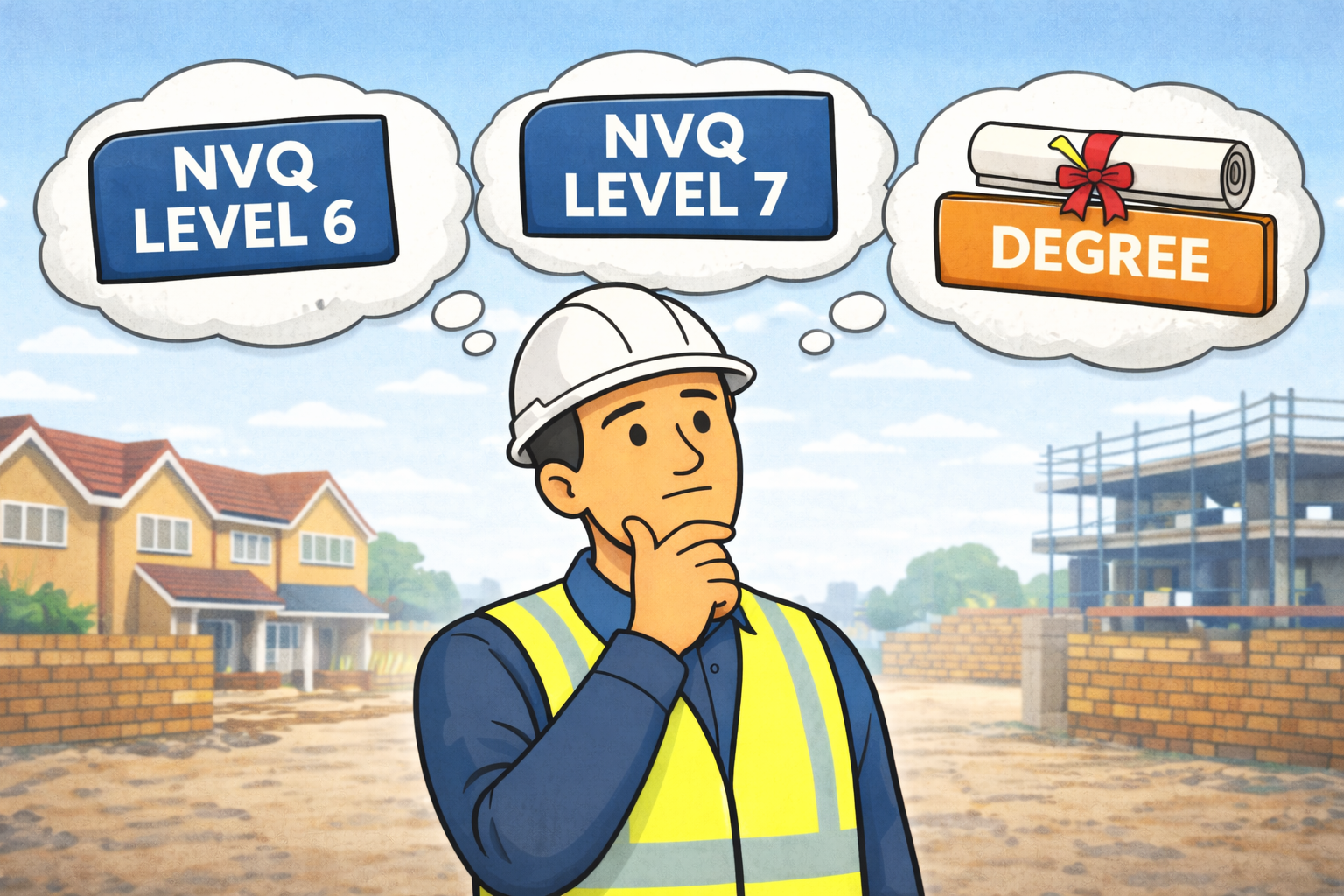
Do You Legally Need a Qualification?
There is no regulation that automatically stops someone calling themselves a site manager. However, you are responsible for health and safety, subcontractors, programme, quality and overall site control. Because of that, employers and clients expect formal evidence that you are competent.
In practice, that evidence usually comes in the form of a Level 6 construction management NVQ.
The NVQ Route – Proven Competence on Site
A Level 6 NVQ Diploma in Construction Site Management or Level 6 NVQ Diploma in Construction Contracting Operations Management is designed for people already doing the job.
You are assessed on what you actually do on site. That includes planning work, managing subcontractors, controlling quality, dealing with health and safety, and keeping projects on programme.
There are no lectures, no essays and no classroom exams. You provide real workplace evidence and complete professional discussions with an assessor who understands construction.
This is the recognised route to the Black CSCS Manager Card. For full qualification details, including units and how assessment works, refer to the NVQ pages linked above.
What About a Construction Degree?
A construction management degree is an academic route into the industry. It usually involves three to four years of study, lectures, coursework and exams. It can cost many thousands of pounds in tuition fees.
A degree teaches theory and broader industry knowledge. That can be valuable, especially for people entering construction at an early stage.
However, a degree on its own does not qualify you for a Black CSCS Manager Card.
Degree holders can apply for the White Academically Qualified Person (AQP) CSCS Card. That card shows academic achievement. It does not demonstrate assessed site management competence.
In UK construction, the Black CSCS Manager Card is generally preferred for site management roles because it shows you have been assessed against real, practical responsibilities.
What About SMSTS?
SMSTS (Site Management Safety Training Scheme) is a short health and safety course. Many companies like to see it, and it can strengthen your CV.
But SMSTS is a short course. It is not a full management qualification and it does not replace an NVQ.
If your goal is the Black CSCS Manager Card, SMSTS alone will not get you there.
The Black CSCS Manager Card – The Recognised Standard
To apply for the Black CSCS Manager Card, you must hold a relevant construction management qualification, most commonly a Level 6 or Level 7 NVQ, and you must pass the CITB Managers and Professionals Health, Safety and Environment (MAP) test.
The old Industry Accreditation route (often called grandfather rights) closed on 31 December 2024. Even if you previously held a Black card through that route, you now need a recognised NVQ and the MAP test to apply again.
Which Level Applies to You?
If you are already doing the role, the practical, recognised route is to complete the NVQ that matches your actual duties and apply for your Black CSCS Manager Card.